

You’ve been dealing with neck pain that just won’t go away. And now your arm aches, your fingers tingle, or you feel a sharp zap running down your shoulder whenever you turn your head a certain way.
You might have already seen a doctor. Maybe they mentioned a slipped disc, a pinched nerve, or a condition called cervical radiculopathy. Or maybe you’ve been quietly googling your symptoms and found yourself here.
Either way, you’re in the right place.
At ONI Physio Fitness in Mont Kiara, Kuala Lumpur, we help people recover from cervical radiculopathy every week. We know how disruptive it is, not just the pain, but the worry, the uncertainty, and the way it stops you from doing the things you love.
This guide will walk you through everything you need to know: what cervical radiculopathy actually is, how to recognise it, what causes it, how we treat it, and what your recovery journey looks like.
Let’s break it down.
What Is Cervical Radiculopathy? (And Why Your Arm Pain Is Actually a Neck Problem)

Here’s something that surprises a lot of people: arm pain, hand tingling, and finger numbness are often not an arm problem at all. They’re a neck problem.
Cervical radiculopathy happens when a nerve root in your neck gets compressed or irritated. The cervical spine (the neck portion of your spine) has seven vertebrae — C1 to C7 — with nerve roots branching out between each level. When one of those nerve roots gets pinched, it sends symptoms all the way down the path of that nerve, which can reach your shoulder, arm, forearm, and fingers.
Think of it like stepping on a garden hose. The problem is at the hose, but the effect shows up at the other end.
The most commonly affected levels are:
- C5–C6: pain and tingling into the thumb and index finger, often with shoulder aching
- C6–C7: symptoms into the middle finger, triceps, and forearm
- C7–T1: ring and little finger numbness, sometimes confused with carpal tunnel or cubital tunnel syndrome
This matters because treating your arm won’t fix the problem. The source is in your neck, and that’s exactly where we need to work.
Cervical Radiculopathy Symptoms: What Does It Actually Feel Like?
Cervical radiculopathy is one of those conditions that shows up differently for everyone. Some people feel it as a dull ache. Others describe it as electric shocks or a burning sensation. Many people are frustrated because they’ve tried treating their shoulder or arm separately, with no results.
Here are the most common signs:
Neck Pain Radiating Down the Arm
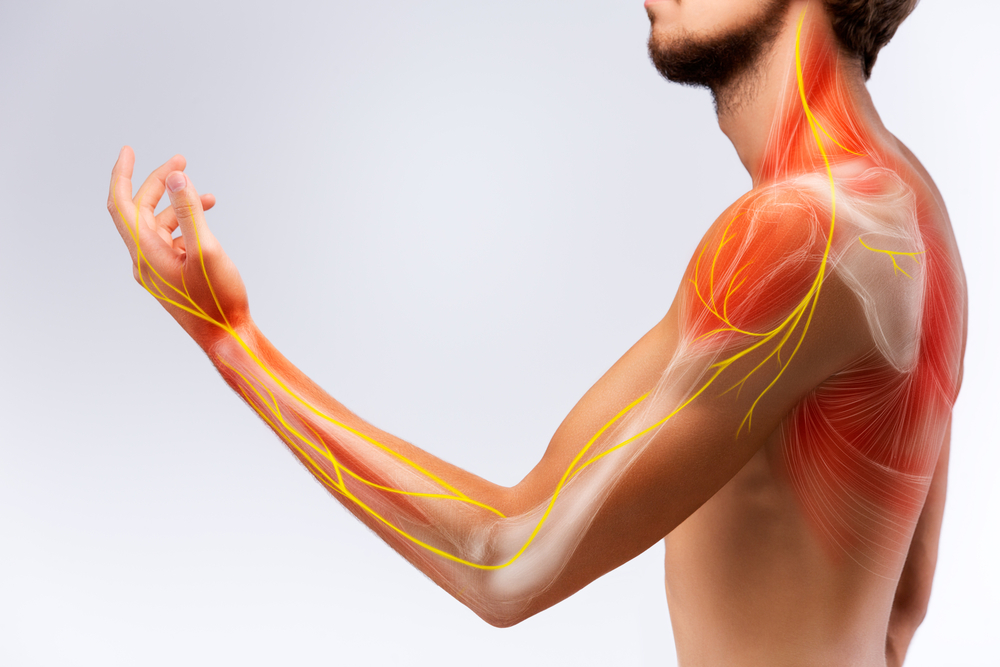
This is the classic sign. Pain that starts in the neck and travels through the shoulder, down the arm, and sometimes into the hand. It can come and go, or it can be constant.
It often gets worse when you look up, tilt your head to the side, or sleep in certain positions.
Numbness in Fingers and Neck Pain
If your fingers feel numb, tingly, or like they’ve ‘fallen asleep’, that’s the nerve root sending a signal that it’s under pressure. The specific fingers affected can tell us which cervical level is involved — something we assess carefully in your first appointment.
Other Symptoms to Watch For
- Weakness in your shoulder, arm, or grip — you might notice it when lifting, gripping, or typing
- A heavy or dead-arm feeling, especially in the morning
- Pins and needles that come and go throughout the day
- Stiffness in the neck with limited range of motion
- Headaches that start at the base of your skull
Seek emergency care if you have numbness or weakness in BOTH arms, difficulty walking, or any changes in bladder or bowel control. These can be signs of a spinal cord issue that needs urgent attention.
Difference Between Neck Strain and a Pinched Nerve: How to Tell Them Apart
A lot of people come to us after weeks of neck pain that they assumed was just a strain or a pulled muscle. It’s easy to confuse the two, but the treatment is very different.
Neck Strain | Cervical Radiculopathy | |
Pain location | Neck and upper shoulder only | Neck AND down the arm or hand |
Arm tingling/numbness | Not usually | Yes, often a key symptom |
Arm weakness | No | Possible |
What caused it | Muscle or ligament overstretching | Compressed nerve root in the neck |
How long does it last | Improves within 1–2 weeks with rest | Persists without proper treatment |
What happens if untreated | Usually resolves on its own | Can worsen; nerve damage possible |
The key takeaway: if your neck pain comes with any arm symptoms at all, don’t just wait it out. Get a proper assessment.
What Causes Cervical Radiculopathy?
Cervical radiculopathy develops when something in the cervical spine puts pressure on a nerve root. The most common causes are:
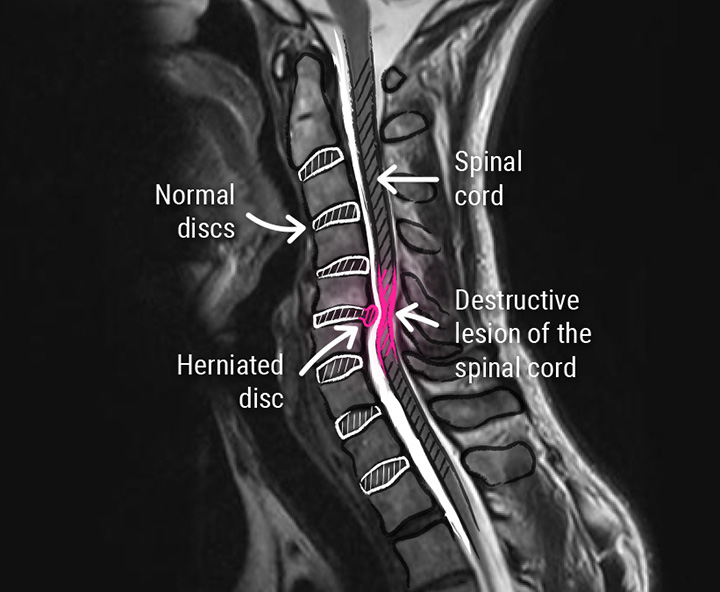
The discs between your vertebrae act as cushions. When the inner part of a disc pushes outward, it can press directly on a nearby nerve root. This tends to happen more in younger adults (30s to 40s) and can be triggered by a sudden movement, heavy lifting, or simply built-up stress on the spine over time.
2. Cervical Spondylosis (Age-Related Wear and Tear)
As we get older, discs lose their height and elasticity. The body forms bone spurs to try to stabilise the area, but these can narrow the space where nerve roots exit the spine. This is the main cause of cervical radiculopathy in people over 50.
3. Poor Posture from Long Hours at a Desk

If you work in an office in KLCC, Bangsar South, Mont Kiara, or Petaling Jaya, this one’s for you. Spending 8 to 12 hours a day with your head pushed forward, looking at a laptop or a phone, puts enormous, repeated stress on the lower cervical spine. Over time, it speeds up disc degeneration and raises your risk significantly.
It’s one of the most common patterns we see in KL, and it’s entirely preventable with the right habits and a strong neck.
Read also: 3D Postural Scan – Identify your posture problems and pain causes
4. Gym Injuries and Overhead Loading
Heavy overhead pressing, incorrectly loaded barbell squats, or aggressive lat pull-downs can cause acute disc herniation, especially if the neck and upper back muscles aren’t strong enough to absorb the load. This is something we see regularly in the active gym community around Mont Kiara.
5. KL Lifestyle and Recreational Activities
- Golfers: repetitive neck rotation under load, especially during the swing
- Badminton players: frequent overhead smashes and cervical extension
- Cyclists: sustained neck extension on a road or mountain bike
- Gamers and streamers: hours of forward head posture with little movement
- Long-distance commuters: stuck in Klang Valley traffic in awkward seating positions
How Is Cervical Radiculopathy Diagnosed?
The good news is that an experienced physiotherapist can usually identify cervical radiculopathy through a thorough clinical assessment.
What Happens in Your Assessment at ONI Physio Fitness
Your first session is 45-60 minutes. We don’t rush this. We take the time to understand your full history, listen to how symptoms affect your day, and conduct a detailed physical examination. This includes:
- Dermatomal and myotomal testing: tracing the pattern of your symptoms to identify which nerve root is involved
- Spurling’s Test: a specific neck test that reproduces your arm symptoms — high accuracy for cervical radiculopathy
- Upper Limb Neurodynamic Test (ULNT): checks how freely the nerve moves through the arm — a sensitive nerve root will reproduce your symptoms
- Reflex and strength testing: to identify any nerve-related muscle weakness or reduced reflexes
- Posture and movement assessment: how your neck, upper back, and shoulders are moving and loading
Do You Need an MRI?
Not always, especially at the start. A clinical diagnosis is enough to begin treatment in most cases. If your symptoms are severe, progressing, or not improving after 3 to 4 weeks of treatment, we’ll advise you on whether imaging would help and work alongside your doctor or specialist.
If you already have MRI or X-ray results, bring them along. It gives us a clearer picture from session one.
Cervical Radiculopathy Treatment Options: What Are the Choices?
The research is clear: the large majority of people with cervical radiculopathy (75-90%) get significantly better with conservative (non-surgical) treatment. Surgery is rarely needed.
Here are the main options, from least to most invasive:
- Physiotherapy (what we do): hands-on treatment combined with exercise rehabilitation — the most effective long-term approach
- Short-term pain medication: anti-inflammatories like ibuprofen, prescribed by your doctor to manage acute pain
- Oral steroids: a short course can reduce severe nerve irritation during a bad flare-up
- Cervical epidural steroid injection: for cases where pain is severe and conservative treatment hasn’t worked
- Surgery (ACDF): considered only if symptoms are progressing neurologically or conservative care has failed over 3 to 6 months
At ONI Physio Fitness, we specialise in conservative rehabilitation. We help most of our cervical radiculopathy patients recover fully without injections or surgery and with a stronger, more resilient spine than before.
Physiotherapy for Pinched Nerve in Neck, KL: How We Treat It at ONI Physio Fitness
Every treatment plan we create is personalised. We look at which nerve root is involved, how severe your symptoms are, what your work and lifestyle demand, and what your goals are.
But there are two things that stay consistent in every cervical radiculopathy case we treat:
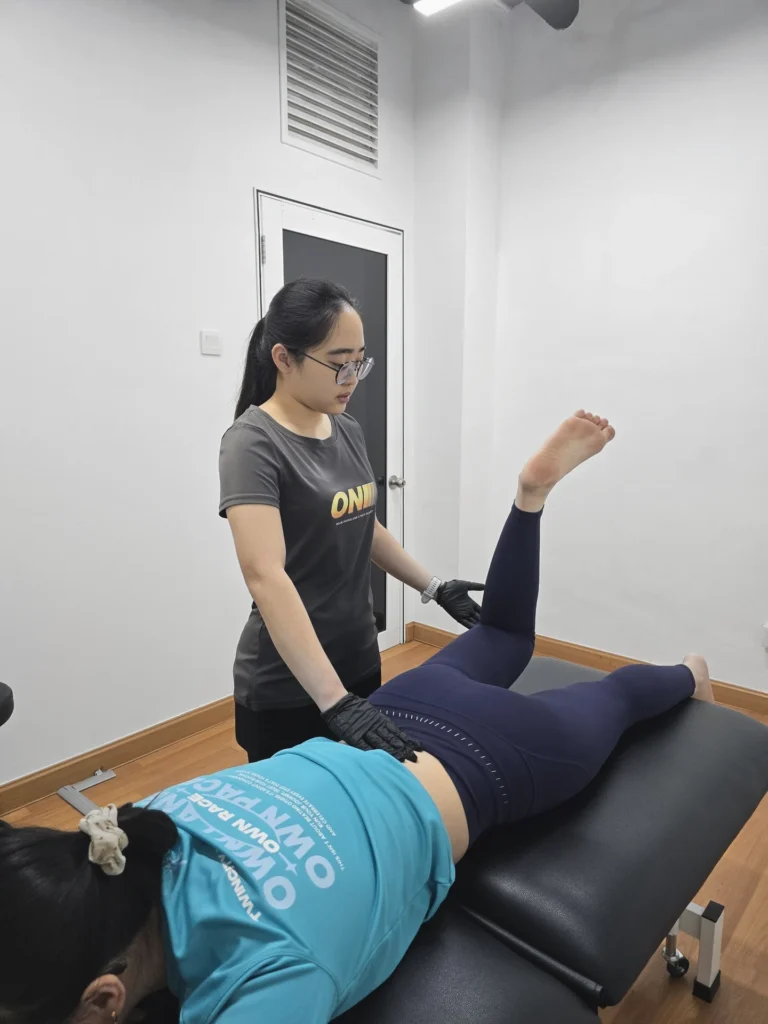
- Hands-on physiotherapy to relieve pressure on the nerve and restore movement in the spine
- Active exercise rehabilitation to build strength that protects you long-term and prevents the problem from coming back
Here’s what that looks like in practice.
Hands-On Treatment (Manual Therapy)
Our physiotherapists use a range of clinical techniques directly on your neck and upper back:
- Cervical joint mobilisation: gentle, precise movements of the stiff facet joints in your neck to restore natural movement and reduce compression
- Soft tissue therapy: releasing the tight muscles around the neck and upper shoulder that go into protective spasm around an irritated nerve
- Thoracic mobilisation: working on the upper back, which often drives poor neck posture and needs to be treated alongside the cervical spine
Active Exercise Therapy: The Part That Actually Makes the Difference
This is where ONI Physio Fitness is different from most clinics in KL.
Passive treatments like heat, massage, and electrical therapy will help you feel better. But they will not stop the problem from coming back. Muscles will. Specifically, the muscles that support and protect your cervical spine.
Our structured exercise programme builds:
- Deep cervical flexor strength: the longus colli and longus capitis muscles (the deep ‘core’ muscles of the neck) are almost always weak in cervical radiculopathy. Rebuilding them takes load off the disc and nerve root
- Scapular stability: strong lower and middle trapezius and serratus anterior muscles reduce the strain placed on your cervical spine every time you use your arm
- Thoracic mobility and posture correction: a stiff, rounded upper back forces the neck to compensate and overload. We fix the source, not just the symptom
- Rotator cuff and shoulder girdle conditioning: important for C5–C6 nerve recovery and overall upper limb function
- Progressive return to full activity: whether that’s lifting heavy at the gym, playing golf, or just carrying your bag without pain
Our team understands fitness and active lifestyles. Whether you lift, play sport, or just want to sit at your desk without pain. We build your rehab around your life, not a generic protocol.
Your Cervical Radiculopathy Recovery Journey: A Clear Treatment Timeline
One of the most common questions we hear is: ‘How long will this take?’
We get it. You want to know what to expect so you can plan your work, your training, and your life. Here’s a realistic roadmap:
Phase | When | What We Focus On | What You’ll Notice |
Phase 1: Pain Relief | Weeks 1–2 | Manual therapy, cervical traction, IFC, postural correction | Neck pain eases, arm aching reduces |
Phase 2: Nerve Recovery | Weeks 3–5 | Nerve gliding, joint mobility exercises, targeted stretching | Tingling improves, neck movement returns |
Phase 3: Strengthening | Weeks 6–10 | Deep neck muscle training, shoulder blade stability, resistance work | Stronger neck, less fatigue at work or gym |
Phase 4: Back to Life | Weeks 10–14 | Sport or work-specific training, full return to activity | Back to gym, golf, badminton, daily life |
These are realistic estimates, not promises. If your case involves multiple disc levels or long-standing spondylosis, recovery can take a little longer. But for most people, you’ll notice clear progress within the first two to three weeks.
Cervical Radiculopathy Self-Help Exercises You Can Try at Home
These exercises are a helpful starting point for many people with cervical radiculopathy. They’re simple, low-risk, and widely used in clinical rehabilitation.
That said, not all exercises suit all presentations. If anything worsens your arm pain or increases your symptoms, stop and see a physio before continuing.
Exercise 1: Chin Tucks
Why it helps: activates the deep neck muscles, reduces forward head posture, and gently decompresses the back of your cervical spine.
- Sit upright in a chair
- Gently draw your chin straight back like you’re making a double chin. Do NOT look down
- Hold for 5 seconds, then release
- 10 repetitions, 3 times a day
Tip: do it against a wall. The back of your head should lightly touch the wall without your chin lifting.
Exercise 2: Cervical Side Glide
Why it helps: a gentle neural mobilisation technique that can reduce arm symptoms, especially in C5–C7 radiculopathy.
- Stand or sit upright in front of a mirror
- Slowly shift your head sideways, away from the arm with symptoms (if right arm, shift left)
- Return to centre. Slow and controlled. 10–15 repetitions
This should feel gentle. If it reproduces your arm pain, stop and get assessed first.
Exercise 3: Scapular Retractions
Why it helps: switches on the lower and middle trapezius, takes pressure off the neck.
- Sit or stand upright, arms relaxed
- Squeeze your shoulder blades together and DOWN towards your back pockets
- Hold 3 seconds, then release. 3 sets of 15 reps
Exercise 4: Thoracic Extension over a Rolled Towel
Why it helps: opens up a stiff upper back that is often at the root of cervical strain.
- Roll a bath towel into a firm log
- Lie on your back with the towel under your mid-back (around bra strap level)
- Let your arms relax overhead and breathe. Hold for 1 to 2 minutes
This is one of the most effective postural resets you can do at home — and most people feel immediate relief.
Exercise 5: Median Nerve Glide
Why it helps: gently mobilises the nerve from the neck all the way to the thumb and index finger (ideal for C6 radiculopathy).
- Sit upright, extend your arm out to the side at shoulder height with your elbow straight
- Tilt your head TOWARD the arm as you pull your wrist back (like stopping traffic)
- Then tilt your head AWAY as the wrist returns to neutral
- 10 slow repetitions, once or twice daily
This should feel like a gentle stretch. Stop if your arm symptoms increase.
Disclaimer: These exercises are for general educational purposes only. They are not a substitute for professional assessment. Individual cervical radiculopathy presentations vary widely, what helps one person may aggravate another. If symptoms worsen, or if you develop new numbness, weakness, or arm pain, stop and seek professional advice. Always consult a physiotherapist before starting any exercise program for a spinal condition.
Want a personalised exercise plan built around your specific nerve level and symptoms? Book your initial assessment at ONI Physio Fitness and we’ll put one together for you from day one.
Quick Self-Assessment: Could You Have Cervical Radiculopathy?
Answer these seven questions honestly. This isn’t a diagnosis but it can help you work out how urgently you need professional input.
Question | Yes | No |
Do you have neck pain AND pain that travels down one arm? | ☐ | ☐ |
Do you get tingling, numbness, or ‘pins and needles’ in your hand or fingers? | ☐ | ☐ |
Does turning or tilting your head make your arm feel worse? | ☐ | ☐ |
Do you notice any weakness in your shoulder, arm, or grip? | ☐ | ☐ |
Have symptoms lasted more than 2 weeks? | ☐ | ☐ |
Has a doctor mentioned disc herniation, spondylosis, or foraminal narrowing? | ☐ | ☐ |
Do you sit at a desk or look at a screen for 6+ hours a day? | ☐ | ☐ |
How did you score?
- 1–2 yes answers: early or low-level concern — monitor symptoms and consider seeing a physio if they persist beyond two weeks
- 3–4 yes answers: cervical radiculopathy is likely — a physiotherapy assessment is recommended soon
- 5–7 yes answers: high likelihood of cervical radiculopathy — don’t delay. Early treatment leads to significantly better outcomes
Disclaimer: This self-assessment is for educational purposes only and does not constitute a medical diagnosis. Only a qualified physiotherapist or doctor can accurately diagnose your condition. If you have progressive weakness or any neurological changes, please seek medical care promptly.
Ready to get a clear answer? Book your assessment at ONI Physio Fitness, Mont Kiara today.
Prevention: How to Protect Your Cervical Spine
The single best thing you can do for your cervical spine is build strength around it. A neck supported by strong, well-conditioned muscles is far less likely to develop radiculopathy and far more likely to recover quickly if it does.
Here are the most practical prevention strategies:
Fix Your Workstation
- Screen at eye level — the top of the monitor should align with your eye line
- Separate keyboard and mouse when using a laptop and use a stand to raise the screen
- Move every 45 to 60 minutes — stand, walk, do a few chin tucks
- Hips and knees at 90 degrees, feet flat, lower back supported
Build a Stronger Neck and Upper Back
- Train your deep neck flexors regularly — chin tucks, neck flexor endurance holds
- Invest in posterior shoulder strength — rows, face pulls, band pull-aparts
- Keep your thoracic spine mobile — foam roll, extension over a towel
- If you lift heavy at the gym, your neck conditioning should match your loading
Frequently Asked Questions
How long does cervical radiculopathy take to heal with physiotherapy?
Most people notice meaningful improvement within 4 to 6 weeks. Full recovery, including building the strength to prevent recurrence, typically takes 10 to 14 weeks. Cases involving significant spondylosis or multi-level disc changes may take a bit longer.
Can physiotherapy treat a herniated disc in the neck?
Physiotherapy can’t physically shrink a disc, but it can decompress the nerve root, reduce inflammation, and restore function. In many cases, disc material does reabsorb over time. The vast majority of cervical disc herniations resolve fully with the right conservative program.
Do I need an MRI before I start physiotherapy?
Not necessarily. A clinical assessment is usually enough to begin treatment. If symptoms are severe, progressing, or not responding after a few weeks, we’ll discuss whether imaging is appropriate. If you already have scans, bring them along.
Can I still exercise with cervical radiculopathy?
Yes, but with appropriate modifications. In fact, exercise is a core part of treatment. High-load overhead pressing or heavy barbell work may need to be adjusted temporarily, but stopping exercise entirely is almost never the answer. We’ll build a plan that keeps you moving safely.
Is a pinched nerve in the neck the same as a slipped disc?
‘Slipped disc’ is a common phrase, but technically discs don’t slip, but they herniate or bulge. A herniated disc is one cause of a pinched nerve in the neck, but spondylosis, bone spurs, and joint stiffness can also cause nerve compression without any disc herniation.
Ready to Get Your Life Back? Book Your Assessment Today
Cervical radiculopathy is one of the most treatable conditions we work with. Most people see clear improvement within two to three weeks of proper treatment and full recovery within two to three months.
But the longer you wait, the more sensitive the nerve becomes, and the longer recovery takes. If you’ve been putting this off, now is the time.