

You twisted your knee, or it has ached for weeks. Now it catches, swells or won’t straighten, and you’ve been told it’s a meniscus tear.
The good part is that many meniscus tears get better with a planned exercise program.
What is a meniscus tear?
The meniscus is a C-shaped pad of tough, rubbery cartilage that cushions the gap between your thigh bone and shin bone. You have two in each knee. A meniscus tear, or torn meniscus, is a split in one of these pads.

Medial and lateral meniscus tears
The medial meniscus is on the inner side of your knee, and the lateral meniscus is on the outer side. About 3 in 4 sudden tears are in the medial one, while lateral tears are more common in young athletes. Meniscus tears also often happen together with an ACL tear, a torn anterior cruciate ligament inside the knee.
What causes a meniscus tear?
A sudden tear is a common sports injury. It happens when you twist your knee hard with your weight on it, like turning fast in football. Kneeling, deep squats and heavy lifting can cause one too.
A wear-related tear, also called a degenerative tear, builds up slowly as you get older. It can happen with no clear injury, and extra body weight raises the risk. These tears often show up on scans of knees with knee osteoarthritis, a condition that makes the joint stiff and painful.

See a doctor first
- Your knee is locked and won’t straighten. A torn piece may be stuck in the joint, and this needs checking early.
- You can’t put weight on your leg, your knee is hot, red and swollen, or you have a fever. These need urgent care.
- Your knee looks out of shape, or your knee or toes feel numb. Go to the emergency department.
- Your knee swelled up badly within hours of a hard twist or fall. This can be a different kind of injury that needs a doctor’s check.
If any of these apply to you, see a doctor rather than a physiotherapist, and go to the emergency department if it came on suddenly or is getting worse. A doctor can arrange a scan if one is needed.
Meniscus tear symptoms: what does it feel like?
The common signs are:
- pain, mostly when you twist or turn your knee
- swelling or stiffness
- trouble straightening your knee all the way
- a popping, catching or locking feeling
- your knee giving way
Pain and swelling can take a day or more to start, mostly with small tears. You might finish your game and wake up with a stiff, swollen knee.

If this sounds like what you’re dealing with, we can assess it properly.
Types and grades: how bad is my tear?
Sudden tears are often long splits, or tears across the meniscus. In a bucket handle tear, a long strip flips into the joint and can lock it. Wear-related tears tend to be flat, flap-shaped or ragged.
An MRI scan shows the soft parts inside your knee, and the report may give your tear a grade. Grades 1 and 2 show wear inside the meniscus, and only grade 3 is a true tear.
Only the outer 10 to 25 percent of the meniscus has a blood supply. Tissue needs blood to heal, so tears near the outer edge heal more easily.
How is a meniscus tear diagnosed?
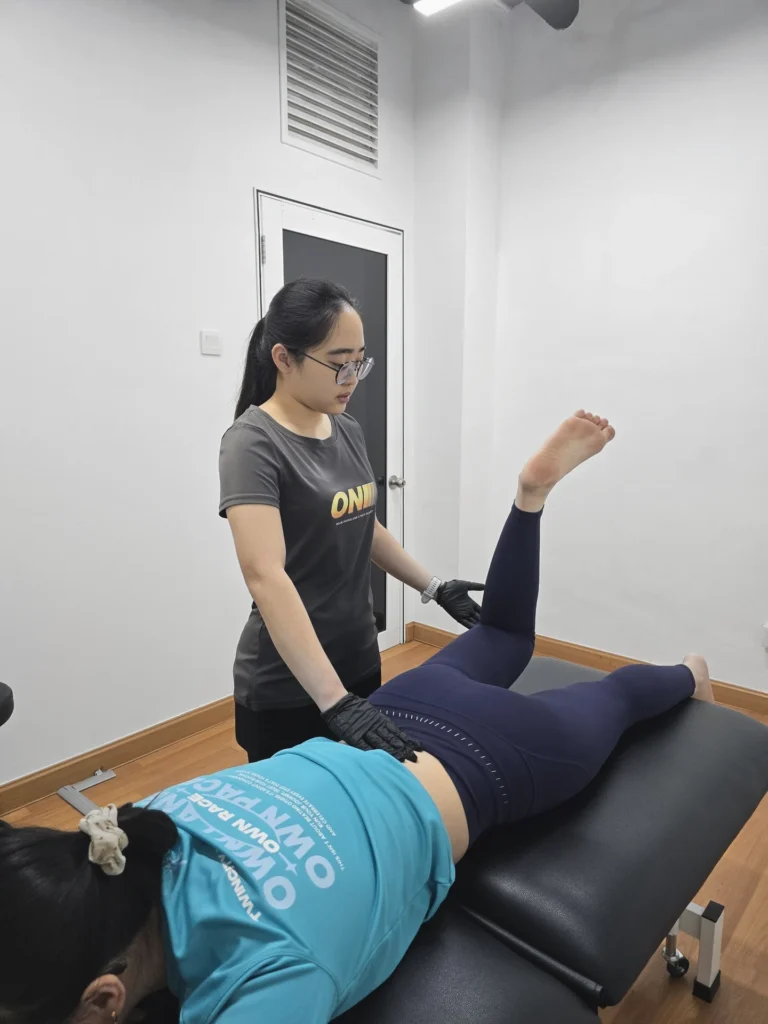
A physio or doctor will ask how it happened. Then they press along the gap between your thigh and shin bones, and move your knee in set ways. No single test can confirm a tear, so they look at the whole picture.
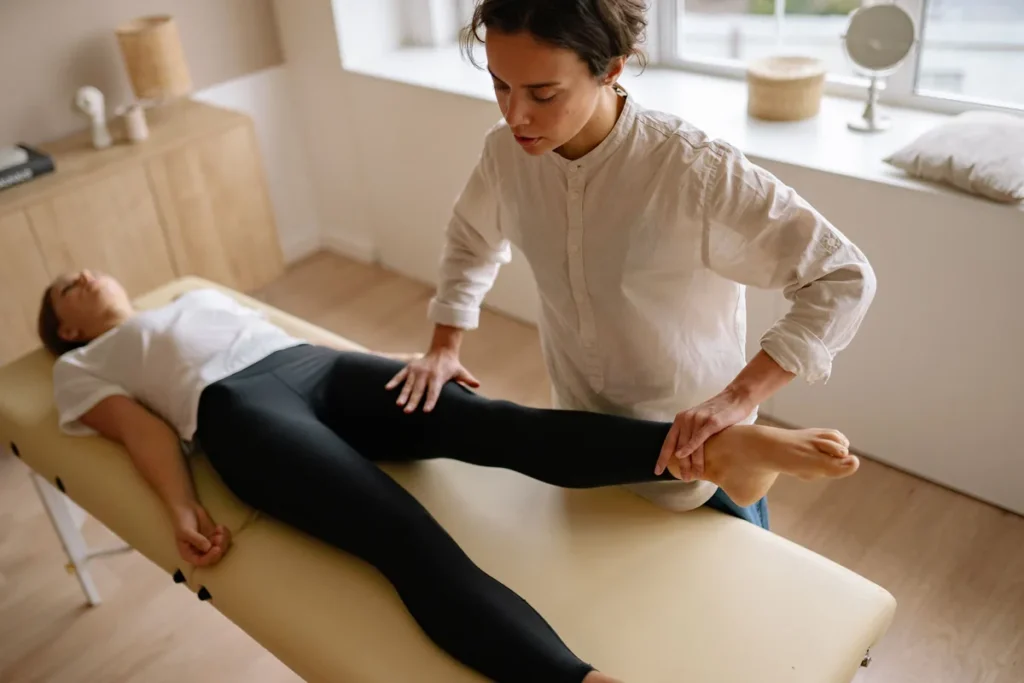
An MRI scan shows tears well, but tears are also common in knees that don’t hurt. Among people aged 50 to 90 with a tear, 61% had no knee pain, aching or stiffness in the past month. So a tear on a scan doesn’t always explain your pain.
Do you need surgery for a meniscus tear?
Talk to a doctor about this, ideally an orthopaedic surgeon, who is a doctor for bones and joints. Every tear is different, and only a doctor can tell you whether surgery is right for yours.
Whatever they advise, rehab is part of getting better. Physio guidelines recommend strength, balance and movement exercises for meniscus tears, with or without surgery. Read more about physiotherapy for knee injuries.
How we treat meniscus tears at ONI Physio Fitness, Mont Kiara
You don’t need a doctor’s referral to start, and you don’t need a scan. If you already have one, bring it along.
Your first session is one-on-one and lasts 45 to 60 minutes. Here’s what happens:
- We ask how you hurt your knee and what it stops you from doing.
- We check how your knee moves, how strong your legs are, and how well you balance.
- We look for what’s causing your symptoms.
- We start treatment on the same day and give you a plan.
Wear loose clothes you can move in, like shorts or gym wear. Most of the session isn’t painful. Some techniques can feel uncomfortable on a sore area, but we keep it within what you can manage.
Your program is built around strength, balance and movement exercises, and we combine physiotherapy with strength training. You see the same physio every session, so they can track your progress and make the exercises harder as you get stronger. If you’ve had surgery, we can work with your surgeon if you ask.
Read more about knee pain physiotherapy in Mont Kiara, or message us on WhatsApp to book an assessment.
Get Your Physiotherapy Treatment Today
Understand your condition better with our detailed physiotherapy assessment, and return to normal life pain-free by addressing your root cause.
Click the button below to book an appointment now!
Treated over 1,000 patients. 30% off first visit
Meniscus tear healing time
| Path | Typical time |
|---|---|
| Exercise-based rehab | Programs tested in trials ran for 12 weeks |
| After trimming surgery (partial meniscectomy) | About 3 to 6 weeks |
| After repair surgery (stitching the tear) | About 3 to 6 months |
Your own time depends on your age, your tear, and the rest of your knee.
Exercises to start with, and what to avoid
These exercises are based on a published 12-week rehab program for meniscus tears, done 2 to 3 times a week. Do the machine exercises one leg at a time, on both legs.
Start with 2 sets of 15. Over the weeks, build up to 3 sets of 12, then 3 sets of 8, then 4 sets of 6 with heavier weights. Some pain is okay, up to 5 out of 10, during and after training.
1. Exercise bike warm-up
- Set the seat so your knee is still slightly bent when the pedal is at the bottom.
- Choose a light resistance.
- Pedal at an easy, steady pace for about 20 minutes.
2. Single-leg knee extension
- Sit on the knee extension machine with the pad on the front of one ankle.
- Hold the handles and keep your back against the seat.
- Slowly straighten your knee and pause for a moment at the top.
- Lower it slowly. Finish your reps, then switch legs.
3. Single-leg hamstring curl
- Set up the hamstring curl machine with the pad behind one ankle.
- Slowly bend your knee to pull the pad toward you.
- Let it back out slowly. Finish your reps, then switch legs.
4. Chair squat
- Stand in front of a sturdy chair, feet hip-width apart.
- Slowly sit back until you just touch the seat, keeping your knees in line over your feet. Don’t let them drop inward.
- Stand back up without using your hands, if you can.
- Use a higher chair if this hurts. Don’t go lower than the seat.
What to avoid for now
Don’t stop moving completely. Gentle movement after the first few days is better than full rest, and avoid heavy carrying. Ease off twisting, deep squats and kneeling, since these are how tears happen.
Nothing prevents every tear, but strong thigh muscles help absorb load at the knee.
Disclaimer
These exercises are for general educational purposes only. They are not a substitute for professional assessment. Individual presentations vary widely. What helps one person may aggravate another. If symptoms worsen, or if you develop new numbness, weakness, or pain, stop and seek professional advice.
Frequently asked questions
Can you walk on a torn meniscus?
Usually, yes, if you can put weight on it. Gentle movement after the first few days is better than full rest. It may hurt more when you turn. If you can’t put weight on the leg, or the knee locks and won’t straighten, see a doctor first.
How long is too long with a torn meniscus?
Give exercise-based rehab a fair try first. Programs tested in trials ran for 12 weeks, and most people’s knees improved over that time. If your knee isn’t getting better after about three months of rehab, or it starts locking, see a doctor to talk about your options.
Should I wear a knee brace with a meniscus tear?
You can. A bandage or knee support can help in the first few days, but take it off when you sleep. A brace may help your knee feel safer. Strength and balance exercises are still the main part of rehab.
Does a torn meniscus hurt all the time?
No. Pain often comes with twisting, turning or squatting, and eases when you rest. Some tears cause no pain at all, and many people have a tear on a scan with no knee pain. If your knee hurts even when you rest, get it checked.
What can be mistaken for a meniscus tear?
Other knee problems can feel the same. Knee osteoarthritis often comes with a tear, and an ACL tear can start with the same pop. Knee bursitis and other causes of knee pain when bending can feel similar. An assessment helps tell them apart.
Can you recover 100% from a torn meniscus?
Many people do, though it can take time. People often get back to what they could do before the injury. Recovery is usually good, though some people’s knees don’t work quite as well as before. Your physio can tell you what to expect for your knee.
Is it better to have a meniscus removed or repaired?
That’s a decision for your surgeon, because it depends on the type of tear and where it is. In general, specialists try to save the meniscus where they can. Ask your surgeon which option suits your tear, and how long recovery takes for each.
What happens if a meniscus tear is left untreated?
Many tears settle with exercise-based rehab, and that counts as treatment too. Meniscus tears are linked to a higher risk of knee osteoarthritis later on. A physio can help you plan your rehab. If your knee keeps locking, swelling or giving way, see a doctor.
Disclaimer
This article is for general information only. It isn’t individual medical advice, and reading it doesn’t create a physiotherapist-patient relationship. Every presentation is different, and what helps one person can aggravate another. If you’re in pain or your symptoms are changing, see a qualified physiotherapist or doctor for an assessment specific to you.
Book an appointment at ONI Physio Fitness, Mont Kiara.
Get Your Physiotherapy Treatment Today
Understand your condition better with our detailed physiotherapy assessment, and return to normal life pain-free by addressing your root cause.
Click the button below to book an appointment now!
Treated over 1,000 patients. 30% off first visit