
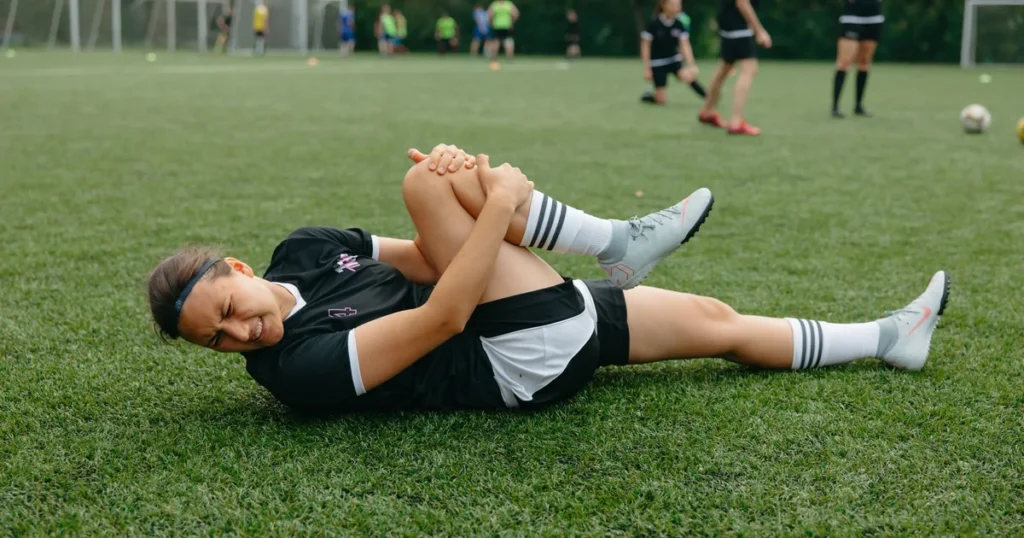
If you play sport, you’ll get hurt at some point. Almost everyone does.
It might be a twisted ankle during badminton, or a knee that starts to hurt after you add more running each week.
Sports injuries come in many forms, but seven of them cover most of what we see. This article explains what they are, how they’re treated, and how long they take to heal.
What is a sports injury?
A sports injury is damage to a part of your body that happens while you play sport or exercise. It can affect your muscles, your bones, or the soft parts that join them together.
There are two main types.
Sudden injuries happen in one moment. You land on someone’s foot, or reach for a shuttlecock and feel something tear. You often hear a pop or a snap, and the area swells up within a few hours.
Slow injuries build up over time. There’s no single moment. At first the area only hurts after you train, then it starts to hurt during training, and later even during the warm-up. By the time you look it up online, it has often been building for weeks.
Slow injuries usually happen because you did too much, too fast. You added more sessions, or trained for longer, or changed to a new shoe or a new court surface. Your body needs time to get used to new work. If you increase the work too quickly, your body can’t keep up.
Two things make any sports injury more likely.
The first is an old injury that never healed properly. If you sprained your ankle two years ago and never did the exercises, that’s the ankle most likely to go again.
The second is being tired. When you’re tired, you move differently, so injuries often happen near the end of a session or near the end of a season.
A small number of sports injuries need a doctor on the same day. You can check the warning signs further down this page.
The 7 most common sports injuries
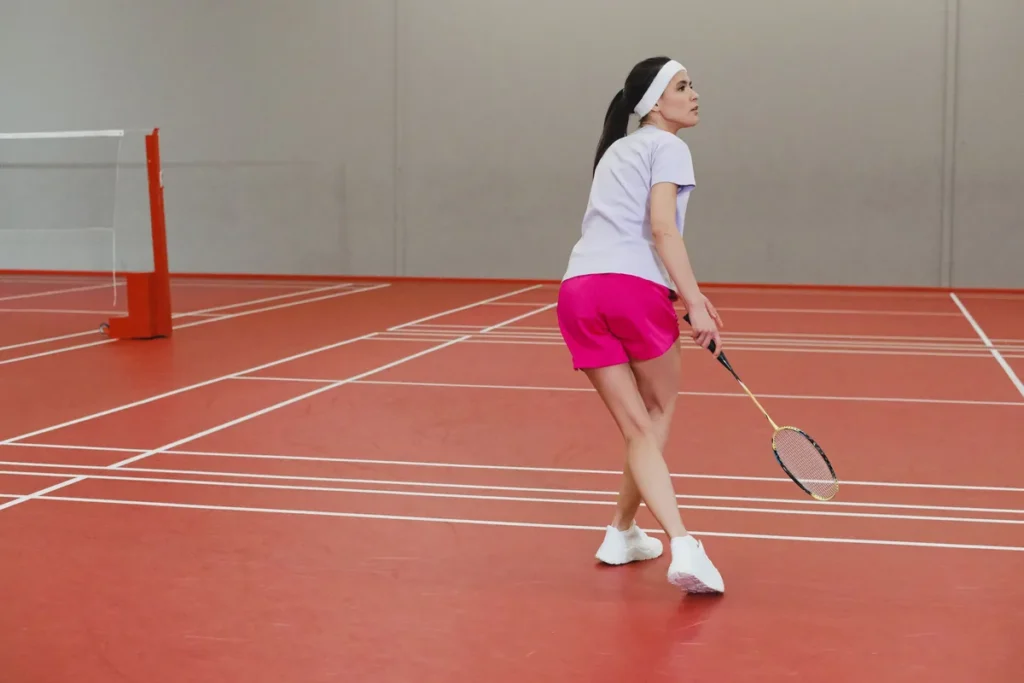
These seven cover most of what we see in badminton, football and futsal, running, and gym training.
1. Ankle sprain
This is the most common sports injury. It happens when your foot rolls inwards and stretches the ligaments on the outside of your ankle. Ligaments are the strong bands that hold your bones together.
You usually land on someone else’s foot, or land badly after a jump.
Your ankle swells up on the outside, hurts to stand on, and often feels weak afterwards, like you can’t trust it.
That weak feeling is the part most people ignore. They rest for a few days, feel better, and go straight back to sport. Then they sprain the same ankle again. Guidelines say it’s better to support the ankle and do exercises than to keep it still (JOSPT guideline, 2021).
If your ankle keeps giving way, ankle and foot physiotherapy can rebuild the strength and balance you lost.
2. Runner's knee (patellofemoral pain)
This is a dull ache around or under your kneecap. It gets worse when you walk down stairs, squat, or sit with your knee bent for a long time.
Runners get it. So does anyone who suddenly does a lot more leg training.
Your kneecap slides in a small groove at the end of your thigh bone. If the muscles that control your kneecap aren’t strong enough for the work you’re doing, the area gets sore.
The treatment is exercise. It works best when you train your hip muscles and your knee muscles together, not just one of them (consensus statement, 2018).
You may also want to read about knee pain after running and IT band syndrome. IT band syndrome causes pain on the outside of the knee instead of the front, and people often mix up the two.
3. ACL tear
The ACL, or anterior cruciate ligament, is a band inside your knee. It stops your lower leg bone from sliding forward or twisting too far.
It tears when you stop suddenly, turn sharply, or land with your knee bending inwards. This is common in futsal, football and court sports.
Most people hear a pop, the knee swells within a few hours, and afterwards it feels like it might collapse under you.
This injury needs a proper check, and often a surgeon’s opinion. Recovery takes a long time either way. There’s more in our guide on what to do after an ACL tear.
4. Hamstring strain
Your hamstrings are the muscles at the back of your thigh. They tear when you run fast, usually at the moment your leg swings forward before your foot lands. Most of these happen in football and futsal.
You feel a sharp pain at the back of your thigh, often in one exact spot. Sprinting becomes impossible for a while.
Hamstring injuries come back easily. It’s better to start strengthening early than to wait until all the pain has gone (JOSPT guideline, 2022).
5. Rotator cuff and shoulder injuries
Your rotator cuff is a group of four small muscles that hold your shoulder in place. They do most of the work when you lift your arm above your head. Badminton, swimming and overhead gym presses all use them heavily.
The pain is usually on the outside of your upper arm. It gets worse when you reach above your head or behind your back, and it often wakes you up at night when you lie on that side.
One useful thing to know: for most rotator cuff pain, exercise works about as well as surgery, and causes fewer problems afterwards (JOSPT guideline, 2025). Surgery is still right for some cases, but it’s not where treatment starts.
There’s more in our guide to rotator cuff injuries.
6. Achilles tendon pain (Achilles tendinopathy)
Your Achilles tendon joins your calf muscle to your heel bone. A tendon is the cord that connects a muscle to a bone.
When it’s injured, the back of your heel feels painful and stiff. It’s worst for your first few steps in the morning, or after you’ve been sitting for a while.
It builds up slowly, usually after you add too much running or jumping too quickly.
Resting makes it feel better, but the pain comes straight back when you play again. That’s because rest doesn’t make the tendon any stronger. Exercise that slowly loads the tendon is the main treatment (JOSPT guideline, 2024).
7. Shin splints
Shin splints cause an ache along the inside edge of your shin bone. Doctors call this medial tibial stress syndrome. The sore area is spread out over several centimeters, not just one small spot.
Runners get it, and so do players in sports with a lot of starting and stopping.
You’re more likely to get shin splints if:
- You carry more body weight
- Your fitness level is low
- Your foot rolls inwards a lot
- Your hips don’t turn very far
These are the known risk factors (review, 2025).
Get this one checked
If the pain sits in one small spot on the bone instead of spreading out, it could be a stress fracture, which is a small crack in the bone. Get that checked, and don’t keep training on it.
When a sports injury needs a doctor
Most sports injuries can be treated by a physiotherapist. A few need a doctor on the same day.
See a doctor today if:
- A joint looks bent or out of shape
- You can’t put any weight on the leg, or can’t use the arm at all
- You heard a loud pop or snap, and the area swelled up very fast
- You feel numbness or pins and needles, or the limb looks pale or feels cold below the injury
- You hit your head, and then felt confused, threw up, had a worse headache, or couldn’t remember things
See a doctor today
If any of these apply to you, see a doctor rather than a physiotherapist, and go to the emergency department if it came on suddenly or is getting worse. A doctor can arrange a scan if one is needed.
Head injuries have their own rule. If someone hits their head and seems unwell in any way, they stop playing for the rest of the day.
A concussion is a brain injury caused by a knock to the head. Players who keep playing after a concussion take longer to get better than players who stop straight away (Elbin et al., Pediatrics, 2016).
How sports injuries are treated
Most advice still starts with RICE: Rest, Ice, Compression, Elevation. You’ll see it on hospital websites and clinic blogs all over Malaysia.
Newer advice has replaced it. The problem with RICE is that it makes people rest for too long.
The current guide for soft tissue injuries is called PEACE and LOVE (Dubois & Esculier, British Journal of Sports Medicine, 2020).
For the first few days, PEACE:
- Protect: avoid movements that hurt
- Elevate: keep the injured part raised
- Avoid anti-inflammatory painkillers if you can
- Compress: use a bandage to control the swelling
- Educate: learn about your injury instead of rushing to get a scan
After that, LOVE:
- Load: start using the injured part again, as much as the pain allows
- Optimism: believe you’ll get better, because this really does affect recovery
- Vascularization (blood flow): keep doing exercise that raises your heart rate
- Exercise: rebuild your strength and movement
The most important word here is “load”. You should protect an injured part for a few days, not for weeks. Your body gets stronger when you use it. So at some point, treatment has to include exercise that slowly builds you back up. If you only rest, the pain may go away, but your strength won’t come back.
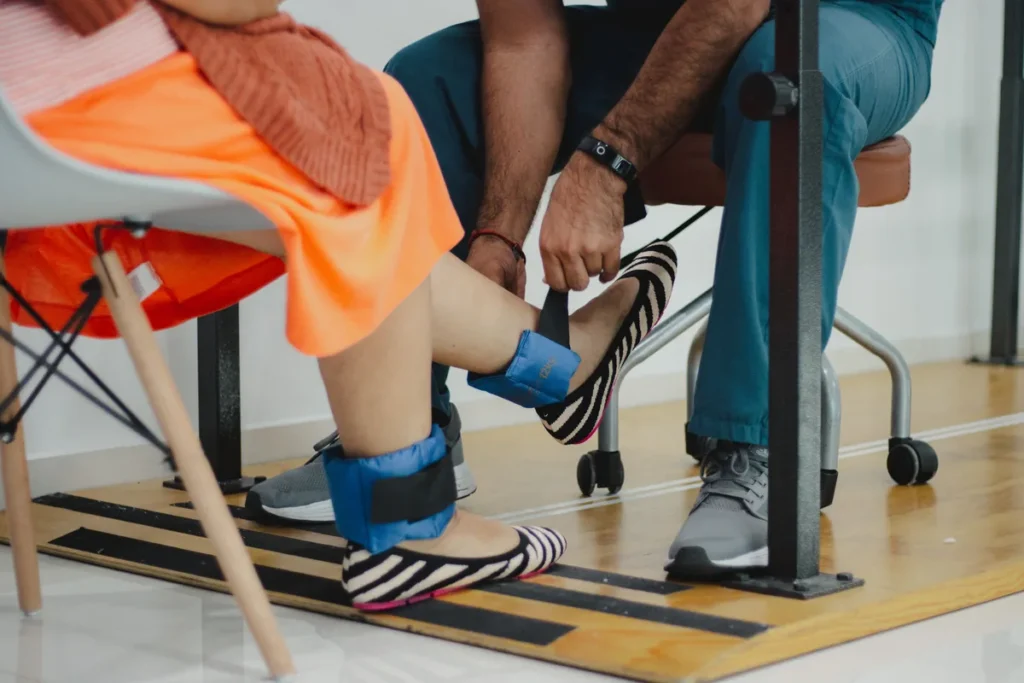
That’s the real job of physiotherapy. We find out what’s injured, work out what you can still do safely, and build you up step by step. You can read more about sports injury physiotherapy in Mont Kiara.
Can you keep playing with a sports injury?
No. The honest answer is that you should stop playing.
If you keep playing, a small injury often becomes a big one. A sore tendon turns into one that hurts all season, and a small muscle tear turns into a large one.
It can also affect you years later. Researchers studied more than 2,000 cricket players. The players who had played while injured were more likely to have lasting joint pain and arthritis. Arthritis is a condition that makes your joints stiff and painful.
If you really want to play, for example because you have an important match, don’t make that decision alone. See a doctor or physiotherapist first and get checked. Then you’ll know what’s damaged and what playing might cost you.
But playing is not the same as training. This is where most people give up too much.
You can usually keep training, as long as you train in a way that doesn’t make the injury worse. Take out the part that hurts. Keep the parts that don’t.
Here’s an example. A badminton player with a sprained ankle can’t move around the court. That doesn’t mean sitting at home for three weeks. They can sit on a chair and practice net shots and racket control, train their upper body, and stay fit in any way that doesn’t load the ankle.
Then, when the ankle is ready, they come back to a body that hasn’t lost all its fitness.
If this sounds like what you’re dealing with, we can assess it properly.
Get Your Physiotherapy Treatment Today
Understand your condition better with our detailed physiotherapy assessment, and return to normal life pain-free by addressing your root cause.
Click the button below to book an appointment now!
Treated over 1,000 patients. 30% off first visit
How long does recovery take?
The answer is boring. It depends.
But there are real reasons for that, and they’re worth knowing.
Different body parts heal at different speeds. A muscle heals faster than a tendon, so the part you injured matters a lot. How bad the injury is matters too. So does how long you’ve had it, because a problem that has been building for six months won’t clear up as fast as one that started last week.
Here are some rough numbers.
Ankle sprains heal fastest. Most players go back to sport within a few days to about three weeks. But that’s usually before the ligament has fully healed, which is one big reason why so many people sprain the same ankle again within a year (JOSPT guideline, 2021).
Tendon problems take months, not weeks. Achilles pain and similar injuries need exercise programs that run for months. If you rush them, they come back.
ACL injuries take the longest. After surgery, about 9 months is the shortest safe time. Young players who went back to sport before 9 months were 7 times more likely to get a new injury than those who waited (JOSPT, 2020).
Don’t stop too early
When your pain stops, it doesn’t mean you’ve healed. The pain usually goes away first, while the injured part is still weak. Many people get injured again during this in-between time.
How to prevent sports injuries
You can’t prevent every injury. But these habits help the most.
Build up slowly. Add distance, weight or sessions little by little, not all at once. This matters most when you’re coming back after a break.
Get strong, not just fit. Strength training is the part most amateur players skip, and it lowers injury risk in every sport. For hamstrings, exercises where the muscle works while it lengthens are especially good.
Warm up properly. A light stretch and a slow jog aren’t enough. Raise your heart rate, move the joints you’re about to use through their full range, and do a few fast efforts before you start.
Be careful in the heat. Malaysia is hot and humid all year, so you get tired faster than players in cooler countries. Tired players move badly, and that’s when injuries happen. Drink before you feel thirsty. If you train outdoors, the middle of the day is the hardest time.
Don’t train through small pains. If something hurts, settles down with rest, then hurts again the moment you play, that’s a slow injury in its early stage. Deal with it now, while it’s small.
Finish treating your old injury. If your ankle still feels weak, or your hamstring tightens every time you sprint, you’re not done yet. An old injury makes a new one much more likely.
Racket sports players often get elbow pain too, and the same slow-loading idea applies. Our guide to tennis elbow exercises explains it.
Disclaimer
This article is for general information only. It isn’t individual medical advice, and reading it doesn’t create a physiotherapist-patient relationship. Every presentation is different, and what helps one person can aggravate another. If you’re in pain or your symptoms are changing, see a qualified physiotherapist or doctor for an assessment specific to you.
Not sure whether your injury is worth checking? That’s usually the best time to check, before it turns into something you have to manage for months.
Get Your Physiotherapy Treatment Today
Understand your condition better with our detailed physiotherapy assessment, and return to normal life pain-free by addressing your root cause.
Click the button below to book an appointment now!
Treated over 1,000 patients. 30% off first visit