
Here is the short answer: yes, targeted exercises work for tennis elbow, and the research is clear on this. But there is a specific order to follow, a specific type of loading that matters most, and one part of the programme that almost every online guide leaves out entirely. This post covers all of it, in plain language, so you can actually get your elbow better rather than just managing it.
One thing worth knowing upfront: tennis elbow is not a life sentence. Most people recover fully. The question is whether you recover fully and it stays that way, or whether you recover, stop doing the work, and find yourself back here in six months.
Let’s make sure it’s the former.
What Is Tennis Elbow — and Why Does It Keep Coming Back?
The actual anatomy, explained simply

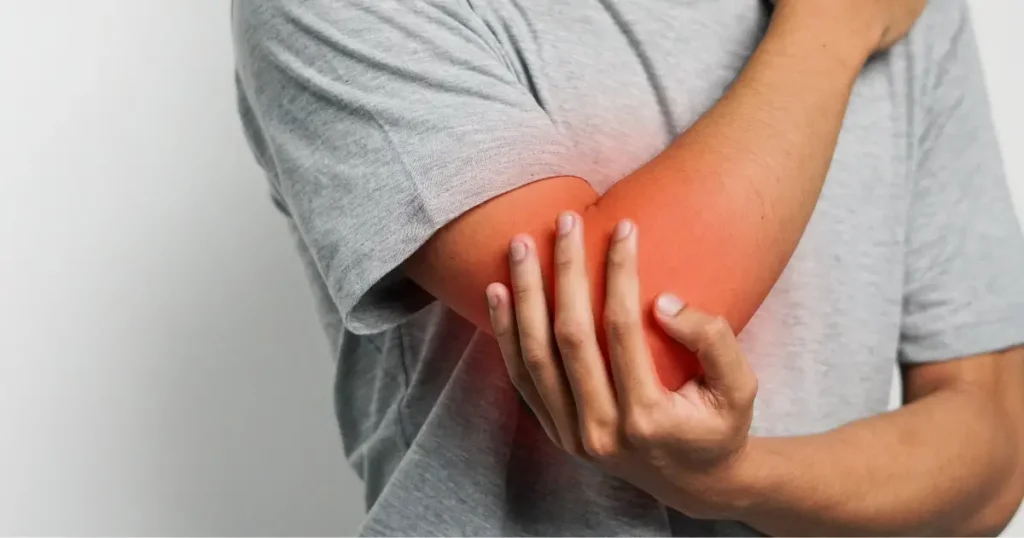
Tennis elbow, known clinically as lateral epicondylitis — meaning inflammation or degeneration at the bony point on the outer side of your elbow — happens when the tendons that attach your forearm muscles to that bony point become overloaded.
The main culprit is usually a tendon called the ECRB — the extensor carpi radialis brevis — a forearm muscle whose job is to stabilise your wrist when your elbow is straight. When you grip, lift, type, swing, or do anything repetitive with your hand and wrist, this tendon is doing a lot of work. Do enough of it, or do it with poor mechanics, and tiny tears start to accumulate faster than the body can repair them.

Here is what most people don’t realise: only about 5% of people with tennis elbow actually get it from playing tennis. The rest get it from painting, carpentry, computer work, cooking, gym training — anything that puts repetitive load through the wrist extensors. The name is just particularly unfair to non-tennis players.
Pain on the outer elbow, weak or painful grip, and difficulty turning a door handle or lifting a coffee cup are the classic signs. If that sounds familiar, read on.
Why "just rest it" tends to backfire
Here is the thing about resting tennis elbow: it makes sense on the surface. The tendon is irritated. Rest means no irritation. Problem solved, right?
Not quite.
Tendons, unlike muscles, have a relatively poor blood supply. They heal through load, not through avoidance. Rest reduces pain, and that is genuinely useful in the very early, acute stage. But as a long-term strategy, resting a tendon is roughly as effective as ignoring a warning light on your dashboard and hoping it goes away. The light is still on. The problem is still there.
What the tendon actually needs is progressive loading — controlled, structured stress applied in increasing amounts over time. That is what drives healing, builds tensile strength in the tendon fibres, and stops the problem from recurring the moment you grip a racket or a steering wheel again.
This is why exercises are not just helpful for tennis elbow — they are the treatment.
Get Your Physiotherapy Treatment Today
Understand your condition better with our detailed physiotherapy assessment, and return to normal life pain-free by addressing your root cause.
Click the button below to book an appointment now!
Treated over 1,000 patients. 30% off first visit
Before You Start: What These Exercises Are Actually Doing
The logic of eccentric loading for tendon rehab
You will see the word eccentric throughout this programme. It refers to a muscle working while it lengthens (the lowering phase of a movement). In a wrist extension exercise, the concentric phase is raising your wrist; the eccentric phase is the slow, controlled lowering.
Eccentric loading is considered the gold standard for tendon rehab, and the evidence behind it is strong. It places the tendon under controlled tension, stimulates collagen production (collagen being the building block of tendon tissue), and does so in a way that promotes repair rather than re-injury, provided you do it progressively and don’t rush the loading.
The key word is slow. The eccentric phase should always take three to five seconds. Do not let your wrist drop. That controlled lowering is where most of the benefit lives.
How to gauge pain during exercise (the 0–5 rule)
You will feel some discomfort during these exercises. That is normal and expected. What you want to avoid is sharp, severe, or worsening pain.
A useful rule: rate your discomfort on a scale of 0 to 10 as you exercise. Staying between 0 and 5 is the target. If you hit 6 or above, reduce the load or range of motion. If your pain is worse the morning after, scale back. If it is the same or slightly better, you are on track.
Pain that is manageable during the exercise and settles within 24 hours is a green light to continue. Pain that lingers or worsens is a signal to back off and potentially a sign that there is something driving the problem that needs proper assessment.
Tennis Elbow Exercises: The Full Programme
Phase 1 — Strengthening (Weeks 1–6)
This is the heart of the programme. Do these 3 times per week, not daily as tendons need recovery time between sessions.
Start without weight for the first week. When you can complete the sets with no increase in pain on two consecutive sessions, add a light weight (a 500ml water bottle works perfectly).
Eccentric wrist extension
You will need a light dumbbell for this one. If you don’t have one, a 500ml or 600ml water bottle works fine.
- Sit at a table with your affected forearm resting flat on the surface, palm facing down, wrist hanging just over the edge. Hold the dumbbell in your affected hand.
- Slowly extend your wrist upward using your own strength.
- At the top, take 3–5 seconds to slowly lower the dumbbell back down to the starting position. Control the movement and do not let it drop.
- The lowering phase is the work. That slow, resisted descent is where most of the healing stimulus comes from.
- Complete 3 sets of 10–15 repetitions. Rest 2 minutes between sets.
Wrist flexion
- Turn your arm over so your palm faces up, wrist hanging over the edge of the table.
- Holding a light weight or water bottle, slowly curl your wrist upward.
- Hold for 1 second at the top, then lower slowly over 3–5 seconds.
- Complete 3 sets of 10–15 repetitions.
Wrist pronation & supination
Hold the dumbbell near one end rather than in the middle, so the offset weight creates a rotational load. If you don’t have a dumbbell, a water bottle works as a substitute.
- Sit with your elbow bent at 90 degrees at your side, forearm resting on a flat table, thumb pointing upward. Hold the dumbbell near one end.
- Slowly rotate your palm downward toward the floor, letting the weight of the dumbbell create gentle resistance through the movement.
- Hold for 1–2 seconds at the bottom, then slowly rotate back to palm-up.
- Perform 3 sets of 10 repetitions in each direction.
Grip strengthening
- Hold a rolled towel or a soft ball in your affected hand.
- Squeeze firmly and hold for 5–10 seconds, then release slowly.
- Repeat 10–12 times. Do 2–3 sets.
This one matters because weak grip strength is not just a symptom of tennis elbow — it is also a driver of it. When the grip muscles fatigue during activity, the forearm tendons absorb more of the load. Build the grip and you reduce the demand on the tendon.
Bold key takeaway: the eccentric lowering phase is where the majority of the healing stimulus comes from. Three to five seconds, controlled, every repetition.
Phase 2 — Shoulder and Scapular Work (The Part Most People Skip)
This is where most exercise guides stop, which is part of why so many people do the programme, feel better for a while, and then find the pain creeping back.
Here is what they miss.
Why the shoulder matters for elbow pain?
Your shoulder and your elbow are not independent structures. They are part of a chain. When your shoulder muscles are weak or poorly coordinated, the forces generated during everyday upper limb movement are not distributed evenly. Your elbow ends up absorbing load that the shoulder should have been managing.
Think of it this way: if a relay team’s first runner is holding back, the second runner has to sprint harder to compensate. Your elbow is that second runner.
This is something we see consistently in the clinic: patients with stubborn tennis elbow who have done all the right forearm exercises but haven’t addressed what’s happening upstream. Their forearm feels better temporarily. Then they return to work, or to the gym, or to the racket, and the load pattern that was overworking the tendon in the first place reasserts itself.
Adding shoulder and scapular work to the programme is not optional once you reach Phase 2. It is what makes the improvement permanent.
Banded shoulder external rotation
You will need a light resistance band for this one. A looped band or a standard therapy band tied at both ends works well.
- Stand side-on to a door or fixed anchor point, with the band attached at roughly waist height. Hold the free end in your affected hand.
- Bend your elbow to 90 degrees and pin it firmly against your side. It should stay there for the entire movement.
- Starting with your forearm pointing across your body toward the anchor point, slowly rotate your forearm outward away from your body until it points straight ahead or slightly past.
- Hold for 1–2 seconds at the end of the range, then slowly return to the starting position over 3 seconds. Control the return. Do not let the band pull your arm back.
- Complete 3 sets of 12–15 repetitions. Switch sides and repeat on the unaffected arm to maintain balance.
Resistance band upper back rows
- Attach a light resistance band to a fixed point at chest height. Stand facing it, holding one end in your affected hand.
- Pull the band back, leading with your elbow and squeezing your shoulder blade back as you do.
- Hold for 1–2 seconds at full contraction, then return slowly.
- Complete 3 sets of 12–15 repetitions.
This exercise targets the muscles that stabilise your shoulder blade during pulling movements, which is exactly the movements most likely to load the lateral elbow in daily life and sport.
When Home Exercises Aren't Enough
Most people with tennis elbow can make significant progress with a structured home programme. But there are situations where you need more than exercises.
See a physiotherapist if:
- Your pain has not improved after 6–8 weeks of consistent, properly performed exercises
- The pain is severe enough to limit basic daily activities like carrying a bag or using cutlery
- You have sharp pain radiating down the forearm or into the hand (this may indicate nerve involvement rather than a straightforward tendon issue)
- You have already been through a period of treatment that helped and then relapsed. This pattern almost always points to a root cause that wasn’t fully addressed
- You are an athlete who needs to return to sport within a specific timeframe
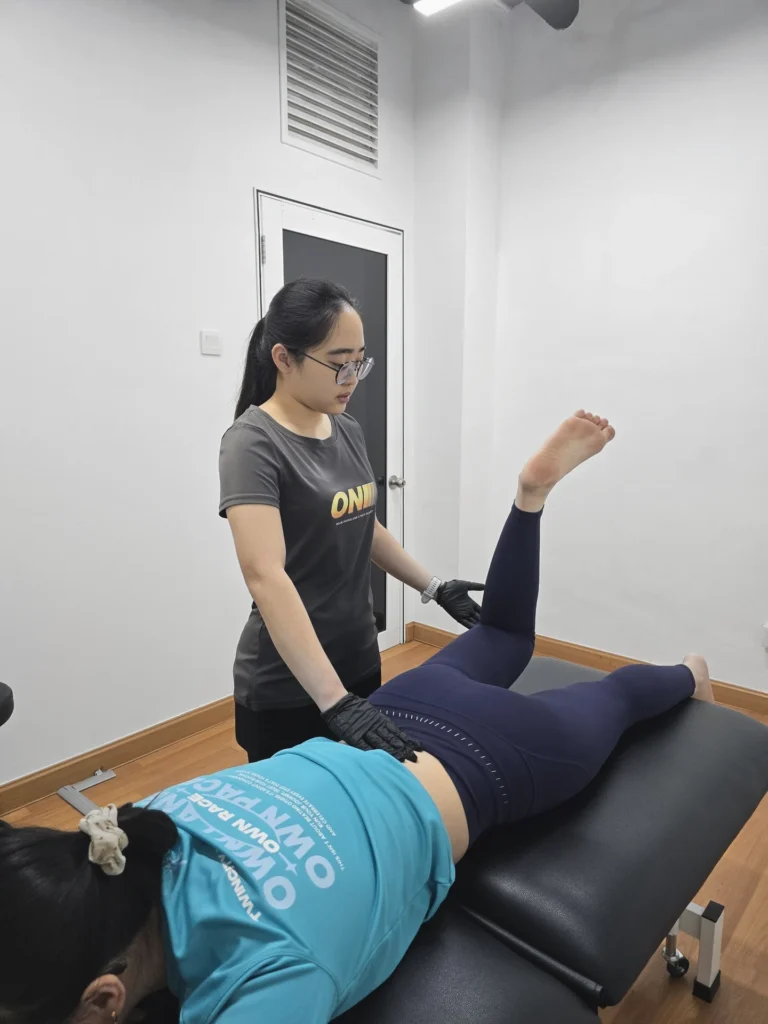
A good physio assessment will not just confirm the diagnosis. It will look at the full picture: your shoulder mechanics, movement patterns, load history, and daily habits, and build a plan around what is actually driving the problem, not just what is making it hurt right now.
Get Your Physiotherapy Treatment Today
Understand your condition better with our detailed physiotherapy assessment, and return to normal life pain-free by addressing your root cause.
Click the button below to book an appointment now!
Treated over 1,000 patients. 30% off first visit
Frequently Asked Questions
How long does tennis elbow take to heal with exercises?
Most people see meaningful improvement within 6–12 weeks of consistent, correctly performed exercises. Full tendon recovery — where the tendon has genuinely rebuilt tensile strength rather than just being less irritated — can take several months. The key word is consistent. Doing the exercises twice and then stopping when the pain fades is a reliable route back to the same problem.
What is the fastest way to cure tennis elbow?
The fastest route to full recovery is combining manual therapy with a structured strengthening programme. Manual therapy reduces pain and tissue tension quickly. In our clinic, most patients with tennis elbow begin to notice real improvement within the first 8-10 sessions. Strengthening makes those gains permanent by addressing the load tolerance of the tendon itself. One without the other tends to produce temporary results.
Should I stop playing tennis or sport if I have tennis elbow?
Not necessarily. For many people, stopping entirely is not the right call. The goal is to modify the load, not eliminate it. Reducing frequency, adjusting technique, and ensuring you are doing adequate warm-up and cool-down allows many athletes to continue training while the tendon heals. If your pain is above a 5 out of 10 during activity, that is a signal to reduce load. If it is manageable and settles within 24 hours afterward, continuing at a reduced level is generally fine.
Can I exercise or go to the gym with tennis elbow?
Yes, with modifications. Avoid movements that load the wrist extensors heavily under high tension, for example, heavy barbell rows with a pronated grip, pull-ups with a narrow grip, or any exercise that causes sharp pain at the outer elbow. Prioritise exercises that don’t aggravate symptoms and continue your rehab programme alongside your training.
What exercises should I avoid with tennis elbow?
Avoid high-load wrist extension against resistance (like heavy barbell curls with a supinated grip taken to end-range), any exercise that produces pain above a 5 out of 10 at the lateral elbow, and high-repetition gripping work before the tendon has built adequate tolerance. The exercises to avoid are not fixed forever. They are just the ones to defer until your capacity is higher.
Is tennis elbow the same as golfer’s elbow?
No. Tennis elbow (lateral epicondylitis) affects the outer side of the elbow and involves the wrist extensor tendons. Golfer’s elbow, or medial epicondylitis, affects the inner side and involves the wrist flexor tendons. They are mirror-image conditions with similar mechanisms but different structures involved and different exercise prescriptions.
What causes tennis elbow if I don’t play tennis?
The condition is caused by repetitive load on the wrist extensor tendons. Tennis just happens to be one activity where that pattern occurs. Painters, carpenters, plumbers, desk workers, gym-goers, and cooks all develop tennis elbow regularly. The mechanism is the same: more cumulative load on the tendon than it has the capacity to manage.
Do I need a brace or strap for tennis elbow?
A counterforce brace (a strap worn just below the elbow) can reduce pain during activity by shifting where load is transmitted through the forearm. It is a useful short-term pain management tool, not a treatment. It does not change the underlying tendon health. Use it if it helps you stay functional while you work through the rehab programme, but do not rely on it as a standalone solution.
When should I see a physiotherapist for tennis elbow?
If your symptoms have been present for more than 4–6 weeks without clear improvement, or if pain is limiting your daily activities and sport, that is a reasonable point to seek a professional assessment. Earlier assessment is better if you have a time-sensitive goal like returning to competition.
Can tennis elbow heal on its own without exercises?
In some mild cases, yes — particularly if the causative activity is removed completely and enough time passes. Studies suggest most cases resolve within a year without specific treatment. But “within a year” is a long time to be in pain, and resolving without exercises does not mean the underlying tendon quality has been restored. People who recover passively are more likely to relapse when they return to the activity.
How do I know if my tennis elbow is serious?
Tennis elbow rarely requires surgery. Approximately 80–95% of cases resolve with conservative management. Red flags that warrant prompt medical attention include: constant pain at rest that doesn’t change with activity, significant swelling around the elbow joint, numbness or tingling in the forearm or fingers, or a sudden severe onset after a specific incident. These may indicate something other than a straightforward tendon problem.
What is the difference between tennis elbow and a muscle strain?
A muscle strain involves tearing of muscle fibres and typically has a more sudden onset, localised swelling, and resolves within days to a few weeks. Tennis elbow involves the tendon, specifically degeneration and micro-tearing at the tendon attachment and develops gradually over weeks to months. The location of pain (outer bony point of the elbow versus the muscle belly) and the nature of onset are the key distinguishing features.
Where to Start Today
Begin with Phase 1 this week. The four strengthening take 20 minutes and you can do them anywhere with simple equipment. Build consistency before adding load.
If you have had tennis elbow before, or if this episode has been going on for more than two months, it is worth getting a proper assessment. Not because the exercises won’t help — they will — but because there is likely something upstream worth looking at properly: shoulder mechanics, load patterns, grip habits, technique. The exercises treat the tendon. The assessment finds out why the tendon got there.
That is exactly what we do at ONI Physio Fitness in Mont Kiara. We assess the full picture, address what is actually driving the problem, and build a plan that is specific to you rather than generic to the condition. If you want to know what is actually going on with your elbow, not just what exercises to try next, book an assessment with us.
Get Your Physiotherapy Treatment Today
Understand your condition better with our detailed physiotherapy assessment, and return to normal life pain-free by addressing your root cause.
Click the button below to book an appointment now!
Treated over 1,000 patients. 30% off first visit